Wednesday, October 01, 2025

Holosplit

 Recently I had to update Mathematica on my laptop and after having solved the challenges of the license manager that keeps looking different every time I have to use it, I learned that Mathematica 14 can now officially work with finite fields.

This reminded me that for a while I wanted to revive an old project that had vanished together with the hard drive of some old computer: Holosplit. So, over the last two days and with the help of said version of Mathematica I did a complete rewrite which you can now find on Github.

It consists of two C programs "holosplit" and "holojoin". To the first you give a positive integer \(N\) and a file and it spits out a new file ("fragment") that is roughly \(1/N\) of the size. Every time you do that you obtain a new random fragment.

The later you give any collection of \(N\) of these fragments and it reproduces the original file. So you can for example distribute a file over 10 people such that when any 3 of them work together, they can recover the original. 

How does it work? I uses the finite field \(F\) of \(2^3=256\) elements (in the Github repository, there is also a header file that implements arithmetic in \(F\) and matrix operations like product and inverse over it). Each time, it is invoked, it picks a random vector \(v\in F^N\) and writes it to the output. Then it reads \(N\) bytes from the file at a time which it also interprets as a vector \(d\in F^N\). It then outputs the byte that corresponds to the scalar product \(v\cdot d\).

To reassemble the file, holojoin takes the \(N\) files with its random vectors \(v_1,\ldots,v_N\) and interprets those as the rows of a \(N\times N\) matrix \(A\). With probability

$$\frac{\prod_{k=1}^N \left(256^N-k\right)}{(256)^{N^2}}$$

which exponentially in \(N\) approaches 1 this matrix is invertible (homework: why?). So we can read one byte from each file, assemble those into yet another vector \(e\in F^N\) and recover

$$d=A^{-1}e.$$

Besides the mathematics, it also poses philosophical/legal questions: Consider for example the original file is copyrighted, for example an mp3 or a video. The fragments are clearly derived works. But individually, they do not contain the original work, without sufficiently many other fragments they are useless (although not in a cryptographic sense). So by publishing one fragment, I do not provide access to the original work. What if others publish other fragments? Then my fragment could be the last remaining one that was missing. If there are more, any individual fragment is redundant so publishing it strictly speaking does not provide new information. 

Friday, February 21, 2025

The Bohm-GHZ paper is out

 I had this neat calculation in my drawer and on the occasion of quantum mechanic's 100th birthday in 2025, I decided I submit a talk about it to the March meeting of the DPG, the German physical society, in Göttingen. And to have to show something, I put it out on the arxiv today. The idea is as follows:

The GHZ experiment is a beautiful version of Bell's inequality that demonstrates you get to wrong conclusions when you assume that a property of a quantum system has to have some (unknown) value even when you don't measure it. I would say it shows quantum theory is not realistic, in the sense that unmeasured properties do not have secret values (different for example from classical statistical mechanics where you could imagine to actually measure the exact position of molecule number 2342 in your container of gas). For details, see the paper or this beautiful explanation by Coleman. I should mention here that there is another way out by assuming some non-local forces that conspire to make the result come out right never the less.

On the other hand there is Bohmian mechanics. This is well known to be a non-local theory (as the time evolution of its particles depend on the positions of all other particles in the system or even universe) but what I found more interesting is also realistic: There, it is claimed that all that matters are particles positions (including the positions of pointers on your measurement devices that you might interpret as showing something different than positions for example velocities or field strengths or whatever) and those have all (possibly unknown) values at all times even if you don't measure them.

So how can the two be brought together? There might be an obstacle in the fact that GHZ is usually presented to be a correlation of spins and in the Bohmian literature spins are not really positions, you will always have to make use of some Stern-Gerlach experiments to translate those into actual positions. But we can circumvent this the other way: We don't really need spins, we just need observables of the commutation relation of Pauli matrices. You might think that those cannot be realised with position measurements as they always commute but this is only true as you do the position measurements at equal times. If you wait between them, you can in fact have almost Pauli type operators.

So we can set up a GHZ experiment in terms of three particles in three boxes and for each particle you measure whether it is in the left or the right half of the box but for each particle you decide if you do it at time 0 or at a later moment. You can look at the correlation of the three measurements as a function of time (of course, as you measure different particles, the actual measurements you do still commute independent of time) and what you find is the blue line in

GHZ correlations vs. Bohmian correlations
   

You can also (numerically) solve the Bohmian equation of motion and compute the expectation of the correlation of positions of the three particles at different times which gives the orange line, clearly something else. No surprise, the realistic theory cannot predict the outcome of an experiment that demonstrates that quantum theory is not realistic. And the non-local character of the evolution equation does not help either.

To save the Bohmian theory, one can in fact argue that I have computed the wrong thing: After measuring the position of one particle at time 0 or by letting it interact with a measuring device, the future time evolution of all particles is affected and one should compute that correlation with the corrected (effectively collapsed) wave function. That, however, I cannot do and I claim is impossible since it would depend on the details of how the first particle's position is actually measured (whereas the orthodox prediction above is independent of those details as those interactions commute with the later observations). In any case, at least my interpretation is that if you don't want to predict the correlation wrong the best you can do is to say you cannot do the calculation as it depends on unknown details (but the result of course shouldn't).

In any case, the standard argument why Bohmian mechanics is indistinguishable from more conventional treatments is that all that matters are position correlations and since those are given by psi-squared they are the same for all approaches. But I show this is not the case for these multi-time correlations.


Post script: What happens when you try to discuss physics with a philosopher:


Wednesday, May 22, 2024

What happens to particles after they have been interacting according to Bohm?

 Once more, I am trying to better understand the Bohmian or pilot wave approach to quantum mechanics. And I came across this technical question, which I have not been able to successfully answer from the literature:

Consider a particle, described by a wave function \(\psi(x)\) and a Bohmian position \(q\) that both happily evolve in time according to the Schrödinger equation and the Bohmian equation of motion along the flow field. Now, at some point in time, the (actual) position of that particle gets recorded, either using a photographic plate oder by flying through a bubble chamber or similar. 

Unless I am not mistaken, following the "having a position is the defining property of a particle"-mantra, what is getting recorded is \(q\). After all, the fact, that there is exactly one place on a photographic place that gets dark was the the original motivation of introducing the particle position denoted by \(q\). So far, so good (I hope).

My question, however, is: What happens next? What value of \(q\) am I supposed to take for the further time evolution? I see three possibilities:

  1. I use the \(q\) that was recorded.
  2. Thanks to the recording, the wave function collapses to an appropriate eigenstate (possibly my measurement was not exact, I just inferred that the particle is inside some interval, then the wave function only gets projected to that interval) and thanks to the interaction all I can know is that \(q\) is then randomly distributed according to \(|P\psi|^2\) (where \(P\) is the projector) ("new equilibrium").
  3. Anything can happen, depending on the detailed inner workings and degrees of freedom of the recording device, after all the Bohmian flow equation is non-local and involves all degrees of freedom in the universe.
  4. Something else
All three sound somewhat reasonable, but upon further inspection, all of them have drawbacks: If option 1 were the case, that would have just prepared the position \(q\) for the further evolution. Allowing this to happen, opens the door to faster than light signalling as I explained before in this paper. Option 2 gives up the deterministic nature of the theory and allows for random jumps of the "true" position of the particle. This is even worse for option 3: Of course, you can always say this and think you are safe. If there are other particles beyond the one recorded and their wave functions are entangled, option 3 completely gives up on making any prediction about the future also of those other particles. Note that more orthodox interpretations of quantum mechanics (like Copenhagen, whatever you understand under this name) does make very precise predictions about those other particles after an entangled one has been measured. So that would be a shortcoming of the Bohmian approach.

I am honestly interested in the answer to this question. So please comment if you know or have an opinion!

Wednesday, January 24, 2024

How do magnets work?

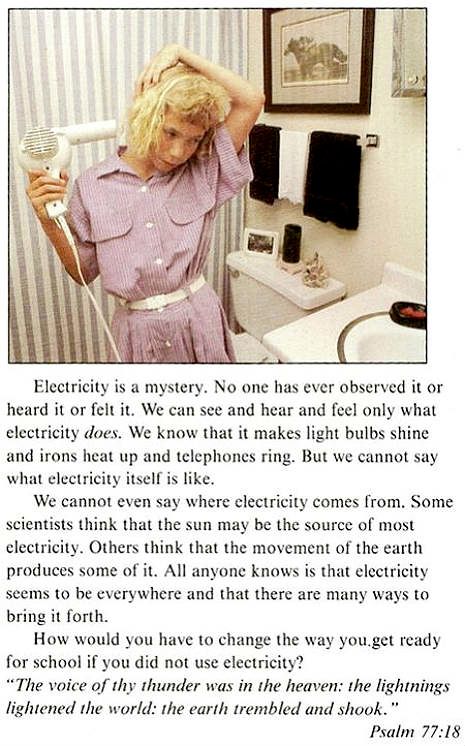
I came across this excerpt from a a christian home schooling book:

which is of course funny in so many ways not at least as the whole process of "seeing" is electromagnetic at its very core and of course most people will have felt electricity at some point in their life. Even historically, this is pretty much how it was discovered by Galvani (using forge' legs) at a time when electricity was about cat skins and amber.

It also brings to mind this quite famous Youtube video that shows Feynman being interviewed by the BBC and first getting somewhat angry about the question how magnets work and then actually goes into a quite deep explanation of what it means to explain something
 

But how do magnets work? When I look at what my kids are taught in school, it basically boils down to "a magnet is made up of tiny magnets that all align" which if you think about it is actually a non-explanation. Can we do better (using more than layman's physics)? What is it exactly that makes magnets behave like magnets?

I would define magnetism as the force that moving charges feel in an electromagnetic field (the part proportional to the velocity) or said the other way round: The magnetic field is the field that is caused by moving charges. Using this definition, my interpretation of the question about magnets is then why permanent magnets feel this force.  For the permanent magnets, I want to use the "they are made of tiny magnets" line of thought but remove the circularity of the argument by replacing it by "they are made of tiny spins". 

This transforms the question to "Why do the elementary particles that make up matter feel the same force as moving charges even if they are not moving?".

And this question has an answer: Because they are Dirac particles! At small energies, the Dirac equation reduces to the Pauli equation which involves the term (thanks to minimal coupling)
$$(\vec\sigma\cdot(\vec p+q\vec A)^2$$
and when you expand the square that contains (in Coulomb gauge)
$$(\vec\sigma\cdot \vec p)(\vec\sigma\cdot q\vec A)= q\vec A\cdot\vec p + (\vec p\times q\vec A)\cdot\vec\sigma$$
Here, the first term is the one responsible for the interaction of the magnetic field and moving charges while the second one couples $$\nabla\times\vec A$$ to the operator $$\vec\sigma$$, i.e. the spin. And since you need to have both terms, this links the force on moving charges to this property we call spin. If you like, the fact that the g-factor is not vanishing is the core of the explanation how magnets work.

And if you want, you can add spin-statistics which then implies the full "stability of matter" story in the end is responsible that you can from macroscopic objects out of Dirac particles that can be magnets.


Monday, November 13, 2023

How not to detect MOND

 You might have heard about recent efforts to inspect lots of "wide binaries", double stars that orbit each other at very large distances, which is one of the tasks the Gaia mission was built for, to determine if their dynamics follows Newtonian gravity or rather MOND, the modified Newtonian dynamics (Einstein theory plays no role at such weak fields). 

You can learn about the latest update from this video by Dr. Betty (spoiler: Newton's just fine).

MOND is an alternative theory of gravity that was originally proposed as an alternative to dark matter to explain galactic rotation curves (which it does quite well, some argue better than dark matter). Since, it has been investigated in other weak gravity situations as well. In short, it introduces an additional scale \(a_0\) of dimension acceleration and posits that gravitational acceleration (either in Newton's law of gravity or in Newton's second law) are weakened by a factor

$$\mu(a)=\frac{a}{\sqrt{a^2+a_0^2}}$$

where a is the acceleration without the correction.

In the recent studies reported on in the video, people measure the stars' velocities and have to do statistics because they don't know about the orbital parameters and the orientation of the orbit relative to the line of sight.

That gave me an idea of what else one could try: When the law of gravity gets modified from its \(1/r^2\) form for large separations and correspondingly small gravitational accelerations, the orbits will no longer be Keppler ellipses. What happens for example if this modified dynamics would result for example in eccentricities growing or shrinking systematically? Then we might observe too many binaries with large/small eccentricities and that would be in indication of a modified gravitational law.

The only question is: What does the modification result in? A quick internet search did not reveal anything useful combining celestial mechanics and MOND, so I had to figure out myself. Inspection shows that you can put the modification into a modification of \(1/r^2\) into 

$$\mu(1/r^2) \frac{\vec r}{r^3}$$

and thus into a corresponding new gravitational potential. Thus much of the usual analysis carries over: Energy and angular momentum would still be conserved and one can go into the center of mass system and work with the reduced mass of the system. And I will use units in which \(GM=1\) to simplify calculations.

The only thing that will no longer be conserved is the Runge-Lenz-vector

$$\vec A= \vec p\times\vec L - \vec e_r.$$

\(\vec A\) points in the direction of the major semi-axis and its length equals the eccentricity of the ellipse.

Just recall that in Newton gravity, this is an additional constant of motion (which made the system \(SO(4,2)\) rather than \(SO(3)\) symmetric and is responsible for states with different \(\ell\) being degenerate in energy for the hydrogen atom), as one can easily check

$$\dot{\vec A} = \{H, \vec A\}= \dot{\vec p}\times \vec L-\dot{\vec e_r}=\dots=0$$

using the equations of motion in the first term. 

To test this idea I started Mathematica and used the numerical ODE solver to solve the modified equations of motion and plot the resulting orbit. I used initial data that implies a large eccentricity (so one can easily see the orientation of the ellipse) and an \(a_0\) that kicks in for about the further away half of the orbit.


Clearly, the orbit is no longer elliptic but precesses around the center of the potential. On the other hand, it does not look like the instantaneous ellipses would get rounder or narrower. So let's plot the orbit of the would be Runge Lenz vector:
Orbit of would be Runge Lenz vector \(\vec A\)


What a disappointment! Even if it is no longer conserved it seems to move on a circle with some additional wiggles on it (Did anybody mention epicycles?). So it is only the orientation of the orbit that changes with time but there is no general trend toward smaller or larger eccentricities that one might look out for in real data.

On the other hand the eccentricity \(\|\vec A\|\) is not exactly conserved but wiggles a bit with the orbit but comes back to its original value after one full rotation. Can we understand that analytically?

To this end, we make use the fact that the equation of motion is only used in the first term when computing the time derivative of \(\vec A\):

 $$\dot{\vec A}=\left(1-\mu(1/r^2)\right) \dot{\vec e_r}.$$

\(\mu\) differs from 1 far away from the center, where the acceleration is weakest. On the other hand, since \(\vec e_r\) is a unit vector, its time derivative has to be orthogonal to it. But in the far away part of the the ellipse, \(\vec e_r\) is almost parallel to the major semi axis and thus \(\vec A\) and thus \(\dot{\vec a}\) is almost orthogonal to \(\vec A\). Furthermore, due to the reflection symmetry of the ellipse, the parts of \(\dot{\vec e_r}\) that are not orthogonal to \(\vec A\) will cancel each other on both sides and thus the wiggling around the average \(\|\vec a\|\) is periodic with the period of the orbit. q.e.d.

There is only a tiny net effect since the ellipse is not exactly symmetric but precesses a little bit. This can be seen when plotting \(\|\vec A\|\) as a function of time:

\(\|\vec A\|\) as a function of time for the first 1000 units of time (brown) and from time 9000 to 10,000 (red)

The same plot zoomed in. One can see that the brown line's minimum is slightly below the red one.
If one looks very carefully, one sees a tiny trend towards larger values of eccentricity.


If one looks very carefully, one sees a tiny trend towards larger values of eccentricity.

This is probably far too weak to have any observable consequence (in particular since there are a million other perturbing effects), but these numerics suggests that binaries whose orbits probe the MOND regime for a long time should show slightly larger eccentricities on average.

So Gaia people, go out an check this!


Friday, April 28, 2023

Can you create a black hole in AdS?

 Here is a little puzzle I just came up with when in today's hep-th serving I found 

  arXiv:2304.14351 [pdf, other]
Operator growth and black hole formation
Comments: 20+9 pages, 10 figures. arXiv admin note: text overlap with arXiv:2104.02736
Subjects: High Energy Physics - Theory (hep-th); General Relativity and Quantum Cosmology (gr-qc); Quantum Physics (quant-ph)

When two particles collide in an asymptotically AdS spacetime with high enough energy and small enough impact parameter, they can form a black hole. 

But to explain it, I should probably say one or two things about thermal states in the algebraic QFT language: There (as we teach for example in our "Mathematical Statistical Physics" class) you take take to distinguish (quasi-local) observables which form a C*-algebra and representations of these on a Hilbert space. In particular, like for example for Lie algebras, there can be inequivalent representations that is different Hilbert spaces where the observables act as operators but there are no (quasi-local) operators that you can use to act on a vector state in one Hilbert space that brings you to the other Hilbert space. The different Hilbert space representations are different super-selection sectors of the theory.

A typical example are states of different density in infinite volume: The difference in particle number is infinite but any finite product of creation and annihilation operators cannot change the particle number by an infinite amount. Or said differently: In Fock space, there are only states with arbitrary but finite particle number, trying to change that you run into IR divergent operators.

Similarly, assuming that the (weak closure) of the representation on one Hilbert space if a type III factor as it should be for a good QFT, states of different temperatures (KMS states in that language) are disjoint, meaning they live in different Hilbert spaces and you cannot go from one to the other by acting with a quasi-local operator. This is proven as Theorem 5.3.35 in volume 2 of the Bratelli/Robinson textbook.

Now to the AdS black holes: Start with empty AdS space also encoded by the vacuum in the holographic boundary theory. Now, at t=0 you act with two boundary operators (obviously quasi-local) to create two strong gravitational wave packets heading towards each other with very small impact parameter. Assuming the hoop conjecture, they will create a black hole when they collide (probably plus some outgoing gravitational radiation). 

Then we wait long enough for things to settle (but not so long as the black hole starts to evaporate in a significant amount). We should be left with some AdS-Kerr black hole. From the boundary perspective, this should now be a thermal state (of the black hole temperature) according to the usual dictionary.

So, from the point of the boundary, we started from the vacuum, acted with local operators and ended up in a thermal state. But this is exactly what the abstract reasoning above says is impossible.

How can this be? Comments are open!

Saturday, November 26, 2022

Get Rich Fast

I wrote a text as a comment on the episode of the Logbuch Netzpolitik podcast on the FTX debacle but could not post it to the comment section (because that appears to be disabled). So in order not to waste I post it here (in German):


1. Hebel (leverage): Wenn ich etwa glaube, dass in Zukunft die Appleaktie weiter steigen wird, kann ich mir eine Appleaktie kaufen, um davon zu profitieren. Die kostet momentan etwa 142 Euro, kaufe ich eine und steigt der Preis auf 150 Euro habe ich natürlich 8 Euro Gewinn gemacht. Besser natürlich noch, wenn ich 100 kaufe, dann mache ich 800 Euro Gewinn. Hinderlich ist dabei nur, wenn ich nicht 14200 Euro dafür zur Verfügung habe. Aber kein Problem, dann nehme ich eben einen Kredit über den Preis von 99 Aktien (also 14038 Euro) auf. Der Einfachheit halber ignorieren wir mal, dass ich dafür Zinsen zahlen muss, die machen das ganze Spiel für mich nur unattraktiver. Ich kaufe also 100 Aktien, davon 99 auf Pump. Ist der Kurs bei 150, verkaufe ich sie wieder, zahle den Kredit ab und gehe mit 800 Euro mehr nach Hause. Ich habe also den Kursgewinn verhundertfacht.


Doof nur, dass ich gleichzeitig auch das Verlustrisiko verhundertfache: Fällt der Aktienkurs entgegen meiner optimistischen Erwartungen, kann es schnell sein, dass ich beim Verkauf der Aktien nicht mehr genug Geld zusammenbekomme, um den Kredit abzuzahlen. Das tritt dann ein, wenn die 100 Aktien weniger wert sind, als der Kredit, wenn also der Aktienwert unter 140,38 Euro fällt. Wenn ich in dem Moment meine Aktien verkaufe, kann ich grade noch meine Schulden bezahlen, habe aber mein Eigenkaptial, das war die eine Aktie, die ich von meinem eigenen Geld gekauft habe, komplett verloren. Ist der Kurs aber noch tiefer gefallen, kann ich beim Spekulieren auf Pump aber mehr als all mein Geld verlieren, ich habe nichts mehr, aber immer noch nicht meine Schulden abbezahlt. Davor hat aber natürlich auch die Bank, die mir den Kredit gegeben hat, Angst, daher zwingt sie mich spätestens, wenn der Kurs auf 140,38 gefallen ist, die Aktien zu verkaufen, damit sie auf jeden Fall ihren Kredit zurück bekommt. Daniel nennt das "glattstellen".


2. Das finde ich natürlich blöd, weil der Kurs viel schneller mal um diese 1,42 Euro fällt, als dass er um 8 Euro steigt. Um das zu verhindern, kann ich bei der Bank noch andere Dinge von Wert hinterlegen, zB mein iPhone, das noch 100 Euro wert ist. Dann zwingt mich die Bank erst meine Aktien zu verkaufen, wenn der Wert der Aktien plus den 100 Euro für das iPhone unter den Wert des Kredits fällt. Sie könnte ja immer noch das iPhone verkaufen, um ihr Geld zurück zu bekommen. Wenn ich aber kein iPhone zum Hintelegen habe, muss ich etwas anderes werthaltiges bei der Bank hinterlegen (collateral).


3. Hier kommen die Tokens ins Spiel. Ich kann mir 1000 Kryptotokens ausdenken (ob mit dem Besitz von computergenerieren Cartoons von Tim und Linus verknüpft ist dabei egal). Da ich mir die nur ausgedacht habe, bin ich noch nicht weiter, so haben sie ja keinen Wert. Ich kann versuchen, sie zu verkaufen, aber dabei werde ich nur ausgelacht. Hier kommt meine zweite Firma, der Investment Fond ins Spiel: Mit dem kaufe ich mir selber 100 der Tokens zum Preis von 30 Euro das Stück ab. Wenn jetzt nicht klar ist, dass ich mir selber die Dinger abgekauft habe (ggf. über einen Strohmann:in) sieht es so aus, als würden die Tokens ernsthaft für einen Wert von 30 Euro gehandelt. Ausserdem verkaufe ich noch den Kunden meines Fonts 100 weitere auch für 30 Euro mit dem Versprechen, dass die Besitzer der Coins Rabatt auf die Gebühren meines Fonds bekommen. Spätestens jetzt ist der Wert von 30 Euro pro Token etabliert. Ich habe von den ursprünglichen 1000 immer noch 800. Jetzt kann ich behaupten, ich habe Besitz im Wert von 24000, denn das sind 800 mal 30 Euro. Diesen Besitz habe ich quasi aus dem Nichts geschaffen, da die Annahme, dass ich auch noch echte Käufer für die anderen 800 bei diesem Preis finden kann, Quatsch ist.


Wenn ich das ganze aber nur gut genug verschleiere, glaubt mir vielleicht jemand, dass ich wirklich auf Werten von 24000 Euro sitze. Insbesonder die Bank aus Schritt 1 und 2 glaubt mir das vielleicht und ich kann diese Tokens als Sicherheit für den Kredit hinterlegen und damit noch höhere Kredite aufnehmen, um damit Apple-Aktien zu kaufen.


Das ganze fliegt erst auf, wenn der Kurs der Aktien so weit fällt, dass die Bank darauf besteht, dass der Kredit zurück gezahlt werden muss. Dann muss ich eben nicht nur die Aktien und das iPhone verkaufen, sondern auch noch die weiteren Tokens. Und dann stehe ich eben ohne Hose da, weil dann klar wird, dass natürlich niemand die Tokens, die ich mir einfach ausgedacht habe, haben will, schon gar nicht für 30 Euro. Dann fehlt in den Worten von Daniel die "Liquidität".


Das ist nach meinem Verständnis, was passiert ist, natürlich nicht mit Apple-Aktien und iPhones, aber im Prinzip. Und der Sinn des mit sich selbst Geschäfte-im-Kreis machen, ist eben, damit künstlich die scheinbaren Preise von etwas, wovon ich noch mehr habe, in die Höhe zu treiben. Der Fehler des ganzen ist, dass schwierig ist, die Werte von etwas zu beurteilen, was gar nicht wirkich gehandelt wird, bzw wo der Wert nur auf anderen angenommenen Werten beruht, wobei sich die Annahmen über die Werte sehr schnell ändern können, wenn jemand "will sehen!" sagt und keine realen Werte (wie traditionell in Form von Fabriken, Know-How etc) dahinter liegen.

Tuesday, October 04, 2022

No action at a distance, spooky or not

 On the occasion of the announcement of the Nobel prize for Aspect, Clauser and Zeilinger for the experimental verification that quantum theory violates Bell's inequality, there seems to be a strong urge in popular explanations to state that this proves that quantum theory is non-local, that entanglement is somehow a strong bond between quantum systems and people quote Einstein on the "spooky action at a distance".

But it should be clear (and I have talked about this here before) that this is not a necessary consequence of the Bell inequality violation. There is a way to keep locality in quantum theory (at the price of "realism" in a technical sense as we will see below). And that is not just a convenience: In fact, quantum field theory (and the whole idea of a field mediating interactions between distant entities like the earth and the sun) is built on the idea of locality. This is most strongly emphasised in the Haag-Kastler approach (algebraic quantum field theory), where pretty much everything is encoded in the algebras of observables that can be measured in local regions and how these algebras fit into each other. So throwing out locality with the bath water removes the basis of QFT. And I am convinced this is the origin why there is no good version of QFT in the Bohmian approach (which famously sacrifices locality to preserve realism, something some of the proponents not even acknowledge as an assumption as it is there in the classical theory and it needs some abstraction to realise it is actually an assumption and not god given).

But let's get technical. To be specific, I will use the CHSH version of the Bell inequality (but you could as well use the original one or the GHZ version as Coleman does). This is about particles that have two different properties, here termed A and B. These can be measured and the outcome of this measurement can be either +1 or -1. An example could be spin 1/2 particles and A and B representing twice the components of the spin in either the x or the y direction respectively.

Now, we have two such particles with these properties A and B for particle 1 and A' and B' for particle 2. CHSH instruct you to look at the expectation value of the combined observable

\[A (A'+B') + B (A'-B').\]

Let's first do the classical analysis: We don't know about the two properties of particle 2, in the primed variables. But we know, they are either equal or different. In case they are equal, the absolute value of A'+B' is 2 while A'-B'=0. If they are different, we have A'+B'=0 while the absolute value of A'-B' is two. In either case, one one of the two terms contribute and in absolute value it is 2 times the unprimed observable of particle one, A for equal values in particle 2 an B for different values for particle 2. No matter which possibility is realised, the absolute value of this observable is always 2.

If you allow for probabilistic outcomes of the measurements, you can convince yourself that you can also realise smaller absolute values than 2 but never larger ones. So much for the classical analysis.

In quantum theory, you can, however, write down an entangled state of the two particle system (in the spin 1/2 case specifically) where this expectation value is 2 times the square root of 2, so larger than all the possible classical values. But didn't we just prove it cannot be larger than 2?

If you are ready to give up locality you can now say that there is a non-local interaction that tells particle 2 if we measure A or B on particle one and by this adjust its value that is measured at the site of particle two. This is, I presume, what the Bohmians would argue (even though I have never seen a version of this experiment spelled out in detail in the Bohmian setting with a full analysis of the particles following the guiding equation).

But as I said above, I would rather give up realism: In the formula above and the classical argument, we say things like "A' and B' are either the same or opposite". Note, however, that in the case of spins, you cannot both measure the spin in x and in y direction on the same particle because they do not commute and there is the uncertainty relation. You can measure either of them but once you decided you cannot measure the other (in the same round of the experiment). To give up realism simply means that you don't try to assign a value to an observable that you cannot measure because it is not compatible with what you actually measure. If you measure the spin in x direction it is no longer the case that the spin in the y direction is either +1/2 or -1/2 and you just don't know because you did not measure it, in the non-realistic theory you must not assign any value to it if you measured the x spin. (Of course you can still measure A+B, but that is a spin in a diagonal direction and then you don't measure either the x nor the y spin).

You just have to refuse to make statements like "the spin in x and y directions are either the same or opposite" as they involve things that cannot all be measured, so this statement would be non-observable anyways. And without these types of statement, the "proof" of the inequality goes down the drain and this is how the quantum theory can avoid it. Just don't talk about things you cannot measure in principle (metaphysical statements if you like) and you can keep our beloved locality.

Thursday, July 21, 2022

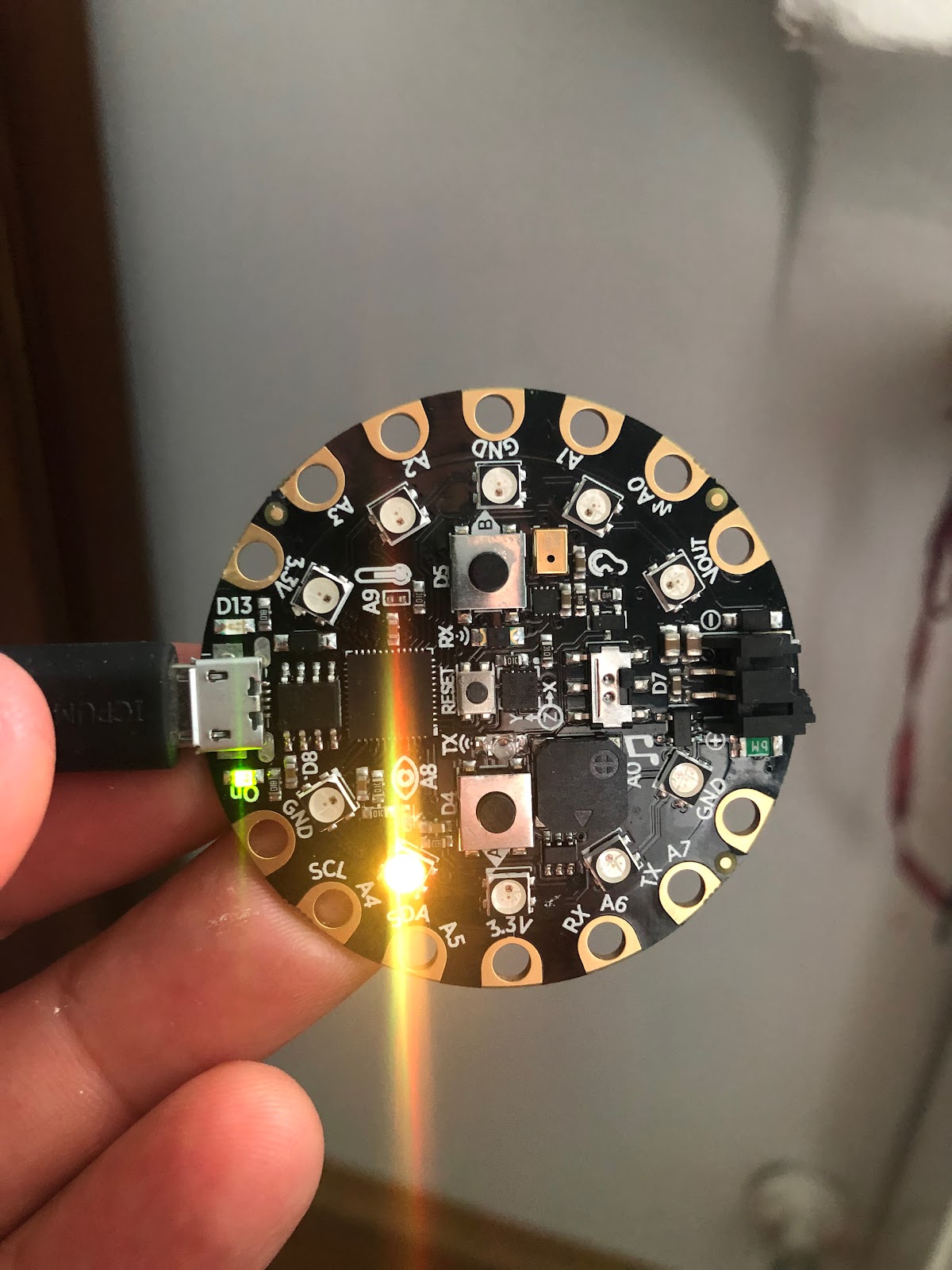
Giving the Playground Express a Spin

 The latest addition to our single chip computer zoo is Adafruit's Circuit Playground Express. It is sold for about 30$ and comes with a lot of GIO pins, 10 RGB LEDs, a small speaker, lots of sensors (including acceleration, temperature, IR,...) and 1.5MB of flash rom. The excuse for buying it is that I might interest the kids in it (being better equipped on board than an Arduino while being less complex than a RaspberryPi.


As the ten LEDs are arranged around the circular shape, I thought a natural idea for a first project using the accelerometer would be to simulate a ball going around the circumference.


The video does not really capture the visual impression due to overexposure of the lit LEDs.

The Circuit Playground Express comes with a graphical programming language (like Scratch) and an embedded version of Python. But you can also directly program it with the Arduino IDE to code in C which I used since this is what I am familiar with.

Here is the source code (as always with GPL 2.0)
// A first project simulating a ball rolling around the Playground Express

#include <Adafruit_CircuitPlayground.h>

uint8_t pixeln = 0;
float phi = 0.0;
float phid = 0.10;

void setup() {
  CircuitPlayground.begin();
  CircuitPlayground.speaker.enable(1);
}

int phi2pix(float alpha) {
   alpha *= 180.0 / 3.141459;
   alpha += 60.0;
   if (alpha < 0.0) 
      alpha += 360.0;
    if (alpha > 360.0)
      alpha -= 360.0;
      
    return (int) (alpha/36.0);
}

void loop() {
    static uint8_t lastpix = 0;
    float ax = CircuitPlayground.motionX();
    float ay = CircuitPlayground.motionY();
    phid += 0.001 * (cos(phi) * ay - sin(phi) * ax);
    phi += phid;
    phid *= 0.997;
    Serial.print(phi);

    while (phi < 0.0) 
      phi += 2.0 * 3.14159265;

    while (phi > 2.0 * 3.14159265)
      phi -= 2.0 * 3.14159265;


    pixeln = phi2pix(phi);
 
    if (pixeln != lastpix) {
      if (CircuitPlayground.slideSwitch())
        CircuitPlayground.playTone(2ssseff000, 5);
      lastpix = pixeln;
    }
    CircuitPlayground.clearPixels(); 
    CircuitPlayground.setPixelColor(pixeln, CircuitPlayground.colorWheel(25 * pixeln));
    delay(0);
}

Saturday, July 09, 2022

Voting systems, once more

 Over the last few days, I have been involved in some heated Twitter discussions around a possible reform of the voting system for the German parliament. Those have sharpened my understanding of one or two things and that's why I think it's worthwhile writing a blog post about it.

The root of the problem is that the system currently in use tries to optimise two goals which are not necessarily compatible: Proportional representation (number of seats for a party should be proportional to votes received) and local representation (each constituency being represented by at least one MP). If you only wanted to optimise the first you would not have constituencies but collect all votes in one big bucket and assign seats accordingly to the competing parties, if you only wanted to optimise the second goal you would use a first past the pole (FPTP) voting system like in the UK or the US.

In a nutshell (glancing over some additional complications), the current system is as follows: We start by assuming there are twice as many seats in parliament as there are constituencies. Each voter has two different votes. The first is a FPTP vote that determines a local candidate that will definitely get a seat in parliament. The second vote is the proportional vote that determines the percentage of seats for the parties. The parties will then send further MPs to reach their allocated lot but the winners of the constituencies are counted as well and the parties only "fill up" the remaining seats from their party list. So far so good, you have achieved both goals: There is one winner MP from each constituency and the parties have seats proportional to the number of (second) votes. Great.

Well, except if a party wins more constituencies  than they are assigned seats according to proportional votes. This was not so much of a problem some decades ago when there were two major parties (conservative and social democrat) and one or two smaller ones. The two parties would somehow share the constituency wins but since those make up only half  of the total number of seats those would not be many more than their share to total seats (which would typically be well above 30% or even 40%).

The voting system's solution to this problem is to increase the total number of seats to the minimal total number such that each party's number of won constituencies is at least as high as their shore of total seats according to proportional vote.

But these days, the two former big parties have lost a lot of their support (winning only 20-25% in the last election) and four additional parties being also represented and not getting much less votes than the two former big ones. In the constituencies it is not rare that you win your FPTP seat with less than 30% of the votes in the constituency and it the last election it can be as low as only 18% sufficient to being the winner of a seat. This lead to the parliament having 736 seats as compared to the nominal size of 598 and there were polls not long before that election which suggested 800+ seats or possibly even over 1000.

A particular case is the CSU, the conservative party here in Bavaria (which is nominally a different party from the CDU, which is the conservative party in the rest of Germany. In Bavaria, the CDU is not competing while in the rest of the country, the CSU is not on the ballot): Still being relative winners here, they won all but one constituencies but got only about 30% of the votes in Bavaria which translates to slightly above 5% of all votes in Germany.

According to a general sentiment, 700+ seats is far too big (for a functioning parliament and also cost wise), so the system should be reformed. But people differ on how to reform it. A simple solution mathematically would be to increase the size of the constituencies to decrease their total number. So the total number of constituency winners to be matched by proportional votes would be less. But that solution is not very popular with the main argument being that those constituents would be too big for a reasonable contact of the local MPs to their constituents. Another likely reason nobody really likes to talk about is that by redrawing district lines by a lot would probably cause a lot of infighting in all the parties because the candidatures would have to be completely redistributed with many established candidates losing their job. So that is off the table, after all, it's the parties in parliament which decide about the voting system by simple majority (with boundary conditions set by relatively vague rules set by the constitution).

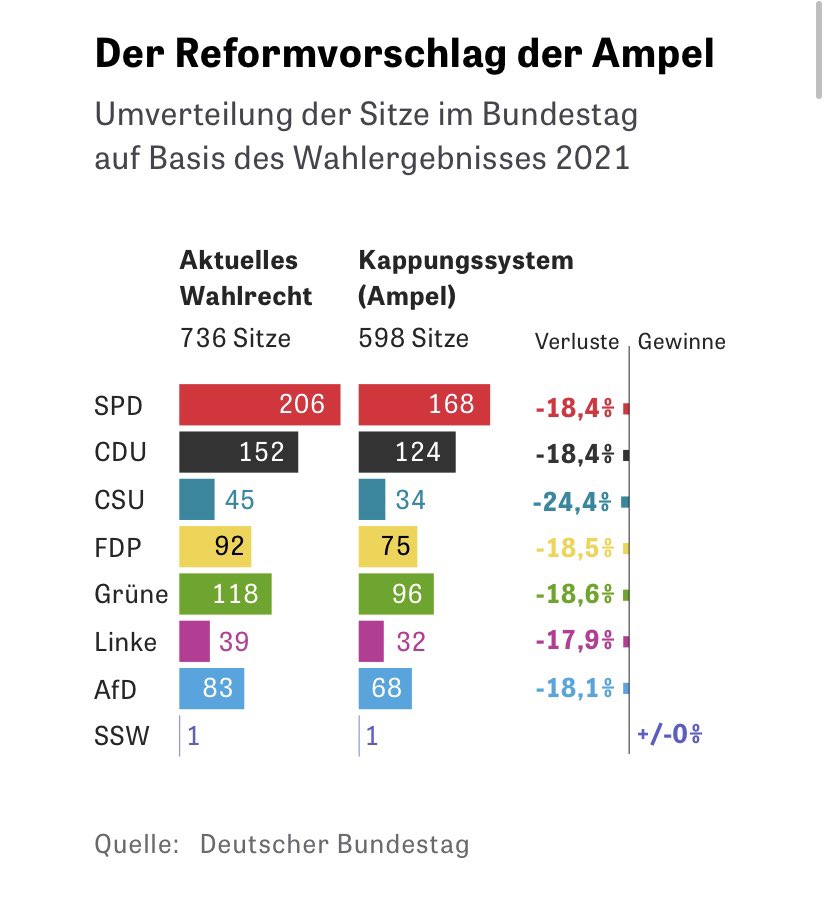
There is now a proposal by the governing social democrat-green-liberal coalition. The main idea is to weaken the FPTP system in the constituencies maintaining the proportional vote: Winning a constituency no longer guarantees you a seat in parliament. If you party wins more constituencies than their share of total seats according to the proportional votes, those constituency seats where the party's relative majority was the smallest would be allocated to the runner up (as that candidates party still has to be allocated seats according to proportional vote). This breaks FPTP, but keeps the proportional representation as well as the principle of each constituency sending at least one MP while fixing the total number of seats in parliament to the magic 598.

The conservatives in opposition do not like this idea (been traditionally the relatively strongest parties and thus tending to win more constituencies). You can calculate how many seats each party would get assuming the last election's votes: All parties would have to give up about 18% of their seats except for the CSU, the Bavarian conservatives, who would lose about 25% since some fine print I did not explain so far favours parties winning relatively many constituencies directly. 

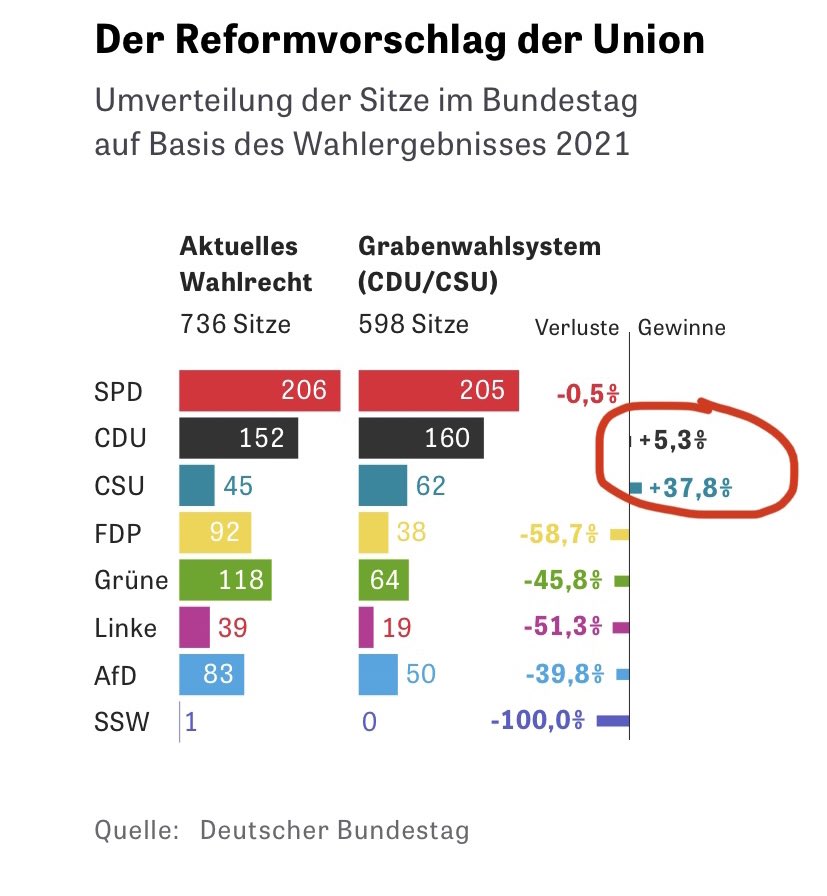
The conservatives also have a proposal. They are willing to give up proportionality in favour of maintaining FPTP and fixing the number of seats to 598: They propose to assign 299 of the seats according to FPTP to constituency winners and only distributing the remaining 299 seats proportionally. So they don't want to include the constituency winners in the proportional calculation.

This is the starting point of the Twitter discussions. Both sides accusing the other side have an undemocratic proposal. One side says a parliament where the majorities do not necessarily (and with current data) unlikely represent majorities in the population is not democratic while the other side arguing that denying a seat to a candidate that won his/her constituency (even by a small relative majority) being not democratic.

Of course it is a total coincidence that each side is arguing for the system that would be better for them (the governing coalition hurting everybody almost equally only the CSU a bit more while the conservative proposal actually benefitting the conservatives quite a bit while in particular hurting the smaller parties that do not win many constituencies or none at all).

ImageImage

(Ampel being the governing coalition, Union being the conservative parties).

Of course, both proposals are in a mathematical sense "democratic" each in their own logic emphasising different legitimate aspects (accurate proportional representation vs accurate representation of local winners).

Beyond the understandable preference for a system that favours one's own political side I think a more honest discussion would be about which of these legitimate aspects is actually more relevant for the political discourse. If a lot of debates would be along geographic lines, north against south, east against west or even rural vs urban then yes, it is very important that the local entities are as accurately represented as possible to get the outcomes of these debates right. That would emphasise FPTP as making sure local communities are most honestly represented.

If however typical debates are along other fault lines, for example progressive vs conservative or pro business vs pro social wealth redistribution then we should make sure the views of the population are optimally represented. And that would be in favour of a strict proportional representation. 

Guess what I think is actually the case.

All that in addition to a political tradition in which "calling your local MP or representative" is a much less common thing that in anglo-saxon countries and studies showing that even shortly after a general election less than a quarter of the voters being able to name at least two of the names of their constituency's candidates casting serious doubts about an informed decision at the local level rather than along party lines (where parties being only needed to make sure there is only one candidate per party in the FPTP system while being the central entity for proportional votes).

PS: The governing coalition's proposal has some ambiguities as well (as I demonstrate here --- in German).

Monday, January 17, 2022

You got me wordle!

 Since a few days, I am following the hype and play wordle. I think I got lucky the first days but I had already put in some strategy as in starting with words where the possible results are most telling. I was thinking that getting the vowels right early is a good idea so I tend to start with "HOUSE" (continuing three vowels and an S) possibly followed by "FAINT" (containing the remaining vowels plus important N and T).

With this start it never took me more than four guesses so far and twice I managed to find the solution in three guesses.


Of course, over time you start thinking how to optimise this. I knew that Donald Knuth had written a paper solving the original Mastermind showing that five moves are sufficient to always find the answer. So today, I sat down and wrote a perl script to help. It does not do the full minimax (but that shouldn't be too hard from where I am) but at least tells you which of your possible next guesses leaves the best worst case in terms of number of remaining words after knowing the result of your guess. 

In that metric, it turns out "ARISE" is the optional first guess (leaving at most 168 out of the possible 2314 words on this list after knowing the result). In any case, here is the source: 

NB: Since i started playing, there was no word that contained the same letter more than once, so I am not 100% sure how those cases are handled (like what color do the two 'E' in "AGREE" receive if the solution is "AISLE" (in mastermind logic, the second would be green the other grey, not yellow) and what when the solution were "EARLY"? So my script does not handle those cases correct probably (for EARLY it would color both yellow).

#!/usr/local/bin/perl -w

use strict;

# Load the word list of possible answers
my @words = ();
open (IN, "answers.txt") || die "Cannot open answers: $!\n";
while(<IN>) {
  chomp;
  push @words, uc($_);
}
close IN;

my %letters = ();
my @appears = ();

# Positions at which letter $l can still appear
foreach my $c (0..25)  {
  my $l = chr(65 + $c);
  $letters{$l} = [1,1,1,1,1];
}


# Running without an initial guess shows that ARISE is the best guess at it leaves 168 words.

&filter("ARISE", &bewerten("ARISE", "SOLAR"));
#&filter("SMART", &bewerten("SMART", "SOLAR"));

# Find the remaining words
my @remain = @words;
# Only keep words containing the letters in @appeads
foreach my $a(@appears) {
  @remain = grep {/$a/} @remain;
}
my $re = &makeregex;

# Apply positional constraints
@remain = grep {/$re/} @remain;


my $min = @remain;
my $best = '';

# Loop over all possible guesses and targets and count how ofter a potential result appears for a guess
foreach my $g(@remain) {
  my %results = ();
  foreach my $t(@remain) {
    ++$results{&bewerten($g, $t)}
  }
  my $max = 0;
  foreach my $res(keys %results) {
    $max = $results{$res} if $results{$res} > $max;
  }
  #print "$g leaves at most $max.\n";
  if ($min > $max) {
    $min = $max;
    $best = $g;
  }
}

print "Best guess: $best leaves at most $min.\n";

# Assemble a regex for the postional informatiokn
sub makeregex {
  my $rem = '';
  foreach my $p (0..4) {
    $rem .= '[';
    foreach my $l (sort keys %letters) {
      $rem .= $l if $letters{$l}->[$p];
    }
    $rem .= ']';
  }
  return $rem;
}

# Find new constraints arising from the result of a guess
sub filter {
  my ($guess, $result) = @_;

  my @a = split //, $result;
  my @w = split //, uc($guess);
  foreach my $p (0..4) {
    my $l = $w[$p];
    if ($a[$p] == 0) {
      $letters{$l} = [0,0,0,0,0];
    } elsif ($a[$p] == 1) {
      &setletter($l, $p, 0);
      push @appears, $l;
    } else {
      foreach my $o (sort keys %letters) {
	&setletter($o, $p, 0);
      }
      &setletter($l, $p, 1);
    }
  }
}

# Update the positional information for letter $l at position $p with value $v
sub setletter {
  my ($l, $p, $v) = @_;
  my @a = @{$letters{$l}};
  $a[$p] = $v;
  $letters{$l} = \@a;
}

# Find the result for $guess given the $target
sub bewerten {
  my ($guess, $target) = @_;
  my @g = split //, $guess;
  my @t = split //, $target;

  my @result = (0,0,0,0,0);
  foreach my $p(0..4) {
    if($g[$p] eq $t[$p]) {
      $result[$p] = 2;
      $t[$p] = '';
      $g[$p] = 'x';
    }
  }
  $target = join('', @t);
  foreach my $p(0..4) {
    if($target =~ /$g[$p]/) {
      $result[$p] = 1;
    }
  }
  return join('', @result);
}

Friday, July 23, 2021

Email is broken --- the spammers won

 I am an old man. I am convinced email a superior medium for person to person information exchange. It is text based, so you don't need special hardware to use it, it can still transport various media formats and it is inter-operational, you are not tied to one company offering a service but thanks to a long list of RFCs starting with number 822 everybody can run their own service.  Via GPG or S/MIME you can even add somewhat decent encryption and authentication (at least for the body of the message) even though that is not optimal since historically it came later.

But the real advantage is on the client side: You have threading, you have the option to have folders to store your emails, you can search through them, you can set up filters so routine stuff does not clog up your inbox. And when things go really pear shaped (as they tend to do every few years), you can still recover your data from a text file on your hard drive.

This is all opposed to the continuous Now of messengers where already yesterday's message has scrolled up never to be seen again. But the young folks tend to prefer those and I cannot see any reason those would be preferable (except maybe that you get notifications on your phone). But up to now, it was still an option to say to our students "if you want to get all relevant information, check your email, it will be there".

But today, I think, this is finally over. The spammers won.

Over the last months of the pandemic, I already had to realise, mailing lists are harder and harder to use. As far as I can tell, nobody offers decent mailing lists on the net (at least without too much cost and with reasonable data protection ambitions), probably because those would immediately be used by spammers. So you have to run your own. For the families of our kid's classes at school and for daycare, to spread information that could no longer be posted on physical notice boards, I tried to set up lists on mailman like we used to do it on one of my hosted servers. Oh, what a pain. There are so many hoops you have to jump through so the messages actually end up in people's inboxes. For some major email providers (I am looking at you hosteurope) there is little chance unless the message's sender is in the recipient's address book for example. And yes, I have set up my server correctly, with reverse DNS etc working.

But now, it's application season again. We have received over 250 applications for the TMP master program and now I have to inform applicants about their results. The boundary conditions is that I want to send an individual mail to everybody  that contains their name and I want to digitally sign it so applicants know it is authentic and not sent by some prankster impersonating me (that had happened in the past, seriously). And I don't want to send those manually.

So I have a perl script (did I mention I am old), that reads the applicants' data from a database, composes the message with the appropriate template, applies a GPG signature and sends it off to the next SMTP server.

In the past, I had already learned that inside the university network, you have to sleep 10 seconds after each message as every computer that sends emails at a higher rate is considered taken over by some spammers and automatically disconnected from the network for 30 minutes.

This year, I am sending from the home office and as it turns out, some of my messages never make it to the recipients. There is of course no error message to me (thanks spammers) but the message seems to be silently dropped. It's not in the inbox and also cannot be found in the spam folder. Just gone.

I will send paper letters as well (those are required for legal reasons anyway) with a similar script and thanks to TeX being text based on the input side. But is this really the answer for 2021? How am I supposed to inform people I have not (yet) met from around the world in a reliable way? 

I am lost.

Friday, June 25, 2021

On Choice

 This is a follow-up to a Twitter discussion with John Baez that did not fit into the 260 character limit. And before starting, I should warn you that I have never studied set theory in any seriousness and everything I am about to write here is only based on hearsay and is probably wrong.

I am currently teaching "Mathematical Statistical Physics" once more, large part of which is to explain the operator algebraic approach to quantum statistical physics, KMS states and all that. Part of this is that I cover states as continuous linear functionals on the observables (positive and normalised) and in the example of B(H), the bounded linear operators on a Hilbert space H, I mention that trace class operators $$\rho\in {\cal S}^1({\cal H})$$ give rise to those via $$\omega(a) = {\hbox tr}(\rho a).$$

And "pretty much all" states arise in this way meaning that the bounded operators are the (topological) dual to trance class operators but, for infinite dimensional H, not the other way around as the bi-dual is larger. There are bounded linear functionals on B(H) that don't come from trace class operators. But (without too much effort), I have never seen one of those extra states being "presented". I have very low standards here for "presented" meaning that I suspect you need to invoke the axiom of choice to produce them (and this is also what John said) and for class this would be sufficient. We invoke choice in other places as well, like (via Hahn-Banach) every C*-algebra having faithful representations (or realising it as a closed Subalgebra of some huge B(H)).

So much for background. I wanted to tell you about my attitude towards choice. When I was a student, I never had any doubt about it. Sure, every vector space has a basis, there are sets that are not Lebesque measurable. A little abstract, but who cares. It was a blog post by Terrence Tao that made me reconsider that (turns out, I cannot find that post anymore, bummer). It goes like this: On one of these islands, there is this prison where it is announced to the prisoners that the following morning, they are all placed in a row and everybody is given a hat that is either black or white. No prisoner can see his own hat but all of those in front of him. They can guess their color (and all other prisoners hear the guess). Those who guess right get free while those who guess wrong get executed. How many can go free?

Think about it.

The answer is: All but one half. The last one says white if he sees an even number of white hats in front of him. Then all the others can deduce their color from this parity plus the answers of the other prisoners behind them. So all but the last prisoner get out and the last has a 50% chance.

But that was too easy. Now, this is a really big prison and there are countably infinitely many prisoners. How many go free? When they are placed in a row, the row extends to infinity only in one direction and they are looking in this infinite direction. The last prisoner sees all the other prisoners.

Think about it.

In this case, the answer is: Almost all, all but finitely many. Out of all infinite sequences of black/white form equivalence classes where two sequences are equivalent if they differ at at most finitely many places, you could say they are asymptotically equal. Out of these equivalence classes, the axiom of choice allows us to pick one representative of each. The prisoners memorise these representatives (there are only aleph1 many, they have big brains). The next morning in the court of the prison, all prisoners can see almost all other prisoners, so they know which equivalence class of sequences was chosen by the prison's director. Now, every prisoner announces the color of the memorised representative at his position and by construction, only finitely many are wrong.

This argument as raised some doubts in me if I really want choice to be true. I came to terms with it and would describe my position as agnostic. I mainly try to avoid it and better not rely too much on constructions that invoke it. And for my physics applications this is usually fine.

But it can also be useful in everyday's life: My favourite example of it is in the context of distributions. Those are, as you know, continuous linear functionals on test functions. The topology on the test functions, however, is a bit inconvenient, as you have to check all (infinitely many) partial derivates to converge. So you might try to do the opposite thing: Let's study a linear functional on test functions that is not continuous. Turns out, those are harder to get hold of than you might think: You might think this is like linear operators where continuity is equivalent to boundedness. But this case is different: You need to invoke choice to find one. But this is good, since this implies that every concrete linear functional that you can construct (write down explicitly) is automatically continuous, you don't have to prove anything!

This type of argument is a little dangerous: You really need more than "the usual way to get one is to invoke choice". You really need that it is equivalent to choice. And choice says that for every collection of sets, the Cartesian product is non-empty. It is the "every" that is important. The collection that consists of copies of the set {apple} trivially has an element in the Cartesian product, it is (apple, apple, apple, ...). And this element is concrete, I just constructed it for you.

This caveat is a bit reminiscent of a false argument that you can read far too often: You show that some class of problems is NP-complete (recent incarnations: deciding if an isolated string theory vacuum as a small cosmological constant, deciding if a spin-chain model is gapped, determining the phase structure of some spin chain model, ...) and then arguing that these problems are "hard to solve". But this does not imply that a concrete problem in this class is difficult. It is only that solving all problems in this class of problems is difficult. Every single instance of practical relevance could be easy (for example because you had additional information that trivialises the problem). It could well be that you are only interested in spin chain Hamiltonians of some specific form and that you can find a proof that all of them are gapped (or not gapped for that matter). It only means that your original class of problems was too big, it contained too many problems that don't have relevance in your case. This could for example well be for the string theory vacua: In the paper I have in mind, that was modelled (of course actually fixing all moduli and computing the value of the potential in all vacua cannot be done with today's technology) by saying there are N moduli fields and each can have at least two values with different values of its potential (positive or negative) and we assume you simply have to add all those values. Is there one choice of the values of all moduli fields such that the sum of the energies is epsilon-close to 0? This turns out to be equivalent to the knapsack-problem which is known to be NP-complete. But for this you need to allow for all possible values of the potential for the individual moduli. If, for example, you knew the values for all moduli are the same, that particular incarnation of the problem is trivial. So just knowing that the concrete problem you are interested in is a member of a class of problems that is NP-complete does not make that concrete problem hard by itself.

What is you attitude towards choice? When is the argument "Here is a concrete, constructed example of a thing x. I am interested in some property P of it. To show there are y that don't have property P, I need to invoke choice. Does this prove x has property P?" to be believed?

Friday, July 10, 2020

Locality Confusion or: What Entanglement Can and Cannot Do For You

I really enjoyed last week's Zoom edition of the annual Strings conference. Clifford has said many of the things about it that I support wholeheartedly, so I don't have to repeat them here. One of the things I really liked was the active participation in the chat channel that accompanied the talks.

But some of the things I read there gave me the impression that there is some confusion out there about locality and things that can happen in quantum theories that showed up in discussions related to black hole information loss (or the lack thereof). So I though, maybe it's a good idea to sort these out.

Let's start with some basic quantum information: Entanglement is strange, it allows you to do things that maybe at first you did not expect. You can already see this in the easy, finite dimensional situation. Assume our Hilbert space is a tensor product
\[H=H_h\otimes H_t\]
of stuff here and stuff there. Further, for simplicity, assume both factors have dimension d and we can pick a basis
\[(e_\alpha)_{1\le \alpha\le d}\]

for both. If we have a maximally entangled state like
\[\Omega = \frac 1{\sqrt d} \sum_\alpha e_\alpha\otimes e_\alpha\]
the first observation is that instead of acting with an operator A here, you can as well act with the transposed (with respect to our basis) operator there, as you can see when writing out what it means in component:
\[(A\otimes id)\Omega = (id\otimes A^T)\Omega = \frac 1{\sqrt d}\sum_{\alpha\beta} a_{\alpha\beta} e_\beta\otimes e_\alpha.\]
That is, with the entangled state, everything, I can do here creates a state that can also be gotten by doing stuff there. And the converse is true as well: Take any state $\psi \in H$. Then I can find an operator $A$ that acts only here that creates this state from the entangled state:
\[ \psi = (A\otimes id)\Omega.\]
How can we find $A$? First use Schmidt decomposition to write
\[\psi = \sum_j c_j f_j\otimes\tilde f_j\]
where the $c$'s are non-negative numbers and both the $f$'s and the $\tilde f$'s are an ortho-normal basis. Define $V$ to be the unitary matrix that does the change of basis from the $e$'s to the $f$'s. Then
\[ A = \sqrt{d\rho_h}V\]
where we used the density matrix $\rho_h$ that is obtained from $\psi$ as a partial trace over the Hilbert space there (i.e. the state that we see here):
\[\rho_h = tr_{H_t}|\Omega\rangle\langle \Omega| = \sum_j c_j |f_j\rangle\langle f_j|.\]
It's a simple calculation that shows that this $A$ does the job.

In other words, you can create any state of the combined here-there system from an entangled state just by acting locally here.

But what is important is that as still operators here and there commute
\[ [A\otimes id, id\otimes B] =0 \]
you cannot influence measurements there by acting here. If you only measure there you cannot tell if the global state is still $\Omega$ or if I decided to act here with a non-trivial unitary operator (which would be the time evolution for my local Hamiltonian $A$).

It is easy to see, that you don't really need a maximally entangled state $\Omega$ to start with, you just need enough entanglement such that $\rho_h$ is invertible (i..e that there are no 0 coefficients in the Schmidt decomposition of the state you start with).

And from this we can leave the finite dimensional realm and go to QFT, where you have the Reeh-Schlieder theorem which tells you essentially that the quantum vacuum of a QFT has this entanglement property: In that setting, here corrensponds to any local neighbourhood (some causal diamond for example) while there is everything space-like localised from here (for a nice introduction see Witten's lecture notes on quantum information).

But still, this does not mean that by acting locally here in your room you can suddenly make some particle appear on the moon that somebody there could measure (or not). QFT is still local, operators with space-like separation cannot influence each other. The observer on the moon cannot tell if the particle observed there is just a vacuum fluctuation or if you created it in your armchair even though RS holds and you can create state with a particle on the moon. If you don't believe it, go back to the finite dimensional explicit example above. RS is really the same thing pimped to infinite dimensions.

And there is another thing that complicates these matters (and which I learned only recently): Localization in gauge theories is more complicated that you might think at first: Take QED. Thanks to Gauß' law, you can write an expression for the total charge $Q$ as an integral over the field-strength over a sphere at infinity. This seems to suggest that $Q$ has to commute with every operator localised in a finite region as $Q$ is localised in a region space-like to your finite reason. But what if that localised operator is a field operator, for example the electron field $\psi(x)$? Does this mean $Q, \psi(x)]=0$? Of course not, since the electron is charge, it should have
\[ [Q,\psi(x)] = e \psi(x).\]
But does that mean that an observer at spatial infinity can know if I apply $\psi(x)$ right here right now? That would be acausal, I could use this to send messages faster than light.

How is this paradox resolved? You have to be careful about the gauge freedom. You can either say that a gauge fixing term you add in the process of quantisation destroys Gauß' law. Alternatively, you can see that acting with a naked $\psi(x)$ destroys the gauge you have chosen. You can repair this but the consequence is that the "dressed" operator is no longer localised at $x$ but in fact is smeared all over the place (as you have to repair the gauge everywhere). More details can be found in Wojciech Dybalski's lecture notes in the very end (who explained this solution to me).

The same holds true for arguments where you say that the total (ADM) mass/energy  in a space time can be measured at spatial infinity.

So the upshot is: Even though quantum theory is weird, you still have to be careful with locality and causality and when arguing about what you can do here and what that means for the rest of the universe. This also holds true when you try to resolve the black hole information loss paradox. Did I say islands?

PimEyes knows what you did last summer

You might have come across news about a search engine for faces: https://pimeyes.com/en/ . You can upload your photo and it will tell you where in the interwebs it has seen you before. Of course, I had to try it. Here are my results:

OK, that was to be expected. This is the image I use whenever somebody asks me for a short bio with a picture or which I often use as avatar. This is also the first hit when you search for my name on Google Images. This is fine with me, this image is probably my pubic persona when it comes to the information super-highway. But still, if you meet me on the street, you can use PimEyes to figure out who I am. But that was to be expected. Then there come some variants of this picture and an older one that I used for similar purposes.

Next come pictures like these:

There seems to be an Armenian politician with some vague resemblance and the internet has a lot of pictures from him. Fine. I can hide behind him (pretty much like my wife whose name is so common in Germany that the mother of one of our daughter's classmates has the same when you only consider first and maiden name as well as a former federal minister).

But then there is this:

And yes, that's me. This is some open air concert one or two years ago. And it's not even full frontal like the sample I uploaded. And there probably 50 other people who are as much recognisable as myself in that picture. And even though this search engine seems not to know about them right now, there must be hundreds of pictures of similar Ali Mitgutsch Wimmelbuch quality that show at which mass activities I participated. I have to admit, I am a little bit scared.

Tuesday, June 16, 2020

Installiert die Corona-Warn-App auch wenn keiner sagt, dass sie sicher ist --- oder ein Lehrstück in Öffentlichkeitskommunikation

Seit heute gibt es sie, die Corona-Warn-App, und ihr könnt (und solltet, siehe unten) sie herunterladen und installieren.

Das ist die kurze Nachricht. Sie hätte auch in einen Tweet gepasst. Warum noch ein Blogpost? Das liegt daran, dass viele Bedenken gegen diese App kursieren und andererseits niemand (insbesondere nicht der CCC) sagt "Alles Quatsch, die App ist sicher!".  Diese Situation würde ich gerne etwas erklären.

Das fängt mit einem Mantra an, dass seit Jahren hergebetet wird: "Sicherheit (im Sinn von Security) ist kein Zustand, sondern ein Prozess". Jede Software, deren Komplexität wesentlich über
10 PRINT "HALLO" 
20 GOTO 10
hinaus geht, wird Bugs haben. Ich zitiere gerne eine alte IBM Studie, die besagt, dass es praktisch nicht gelingt, weniger als 1 Bug pro etwa 10.000 Zeilen Code zu haben, weil man, wenn man den Code weiter versucht zu debuggen und testen, dabei mehr Fehler einbaut als man eliminiert. Selbst der NASA, die sich da sehr viel Mühe gibt, fallen regelmässig Raumsonden wegen Softwarefehlern hart auf Planetenoberflächen. Und das sicher nicht, weil die leichtfertig waren.

Daher kann es nur darum gehen, möglichst wenig Fehler zu produzieren (mit entsprechenden Tests, Audits, Software-Werkzeugen, die einem helfen etc). Aber niemand, der weiss, was er tut, wird garantieren können, dass man alles gefunden hat. Man kann nur dokumentieren, dass man sich Mühe gegeben hat und dabei nach best practices gehandelt hat. Und vor allem: Wenn dann doch ein Fehler auftaucht, muss man die entsprechende Fehlerkultur haben und ihn schnell und effektiv beseitigen. Besser geht's leider nicht. Die Alternative ist nur, keine Computer bzw keine Software zu benutzen.

Und weil Leute, die wissen, wovon sie reden, genau diesen Umstand kennen, lassen sie sich nicht dazu verleiten "Die App habe ich geprüft, sie ist sicher" öffentlich zu sagen.

Was man aber sehr wohl feststellen kann, ist wenn etwas unsicher ist und man eine Lücke gefunden hat. Und das wird ja auch regelmäßig gemacht und auch der CCC hält sich nicht zurück, über Probleme öffentlich zu reden, wenn man sie denn gefunden hat (responsible disclosure beachtend), wie zB in der jüngsten Vergangenheit beim Telematix-Netzwerk im Gesundheitswesen.

Was man sehr wohl hören sollte, ist dass man genau sowas über die Corona-Warn-App zumindest bisher nicht hört. Es gibt sehr wohl die 10 Prüfsteine für eine solche App und am Anfang sah es nicht so aus, als würden sie eingehalten (zB zentrale Serverstruktur, closed source), aber an dieser Stelle beschwert sich momentan niemand. Vielmehr gibt es viel Lob, dass auf Kritik reagiert wurde: Es werden die Kontaktdaten nur lokal auf den Telefonen gespeichert (auch schon weil Apple und Google dies als sinnvoll eingesehen haben und es nicht wirklich eine App gegen die entsprechenden Betriebsystemhersteller gegeben hätte, schon alleine weil die die Betriebssysteme es aus Securitygründen Apps nicht einfach erlauben, dauerhaft und im Hintergrund Bluetooth zu verwenden) und der Source-Code zusammen mit der Entwicklungsgeschichte wurde öffentlich auf GitHub zur öffentlichen Überprüfung zugänglich gemacht. Und die Öffentlichkeit hat tatsächlich Probleme gefunden. Aber diese wurden nicht ignoriert, sondern behoben.

Und genau das ist der Prozess, von dem ich oben sprach. Den darf man auch gerne mal loben und sagen "so soll's sein, gerne wieder". Und das wird ja auch getan. Man muss dem eben nur zuhören und verstehen (was leider nicht so richtig kommuniziert wird), dass dieses Lob eigentlich die bessere Variante des "Zertifikat: die App ist sicher" ist. Hier ist leider das Schweigen nicht laut genug, das "nicht geschimpft ist genug gelobt" ist leider nicht sehr öffentlichkeitswirksam, bzw bedarf einer Erklärung, wie ich sie hier versuche. Update: Linus Neumann, CCC Sprecher, macht es doch.

"Aber es gibt doch Kritikpunkte" höre ich Euch sagen. Ja, die gibt es. Aber schauen wir sie uns an, ob die von ihnen ausgehende Gefahr den möglichen Nutzen der App übersteigen kann:


  • "Man kann Leute tracken" Ja, kann man. Aber nur, wenn man die Republik flächendeckend mit Bluetooth-Empfängern überzieht. Pavel Meyer hat dieses Argument ausführlicher gemacht.
  • "Ich muss Bluetooth anschalten, das hatte schon Lücken in der Vergangenheit." Stimmt. Gilt aber auch für Wifi/Internet. Wenn man sich darum sorgt, empfehle ich das Handy abzuschaffen. Update: Bei Android-Smartphones, die nicht gegen bekannte Probleme gepatched werden können (Android Update nach 1. Februar 2020), ist es vielleicht doch keine gute Idee, Bluetooth einzuschalten. Kann man aber drüber nachdenken, ob das ein Problem der App oder des Smartphones ist.
  • "Die App ist open source, aber was ist mit der Library von Apple/Google?". Stimmt auch. Gilt aber auch für das Betriebssystem des Handys. Wenn Apple/Google euch überwachen wollen und eure Daten raustragen wollen, können sie das nicht erst seit der App. Sondern seit ihr ein Handy benutzt. Also wieder besser: Handy in den Shredder.
  • "Wenn nicht viele die App benutzen, nützt sie nichts" (oder auch in der Version "die App ist nicht verpflichtend, so kann sie nicht funktionieren, also benutze ich sie nicht"). Ja. Henne und Ei. Dann benutz sie doch. Ist wieder ein Beispiel des Gefangenendilemmas, kann man ändern indem man selber kooperiert und hofft, dass die anderen zum gleichen Schluss kommen.
Bleibt noch eine Meta-Frage: Ich möchte eigentlich diese ganze Geschichte auch als eine Erfolgsgeschichte des CCC abbuchen, man hat (nehmen wir mal an, es hat tatsächlich einen Einfluss gehabt) echte Verbesserungen erreichen können. Vor allem wenn man sich vor Augen führt, was am Anfang der Geschichte vorgeschlagen wurde, wie GPS-tracking, eine zentrale, staatliche Kontaktdatenbank etc. Der Umstand, dass hier auf die Expertise gehört wird, ist auch ein langfristiger Erfolg, es wurde verstanden, sich über die Jahre als kompetenter und kritischer Beobachter zu etablieren. Die Öffentlichkeit wurde für entsprechende Themen hellhörig gemacht.

Andererseits lese ich auf social media viel Kritik an der App und Erklärungen, warum sie böse ist oder warum man sie sich selber auf keinen Fall installieren will. Die halbwegs rationalen Einwände habe ich eben aufgezählt (auch wenn meine Kosten-Nutzen-Abwegung klar anders ist und ich first thing this morning mir die App installiert habe), es gibt aber auch unendlich viel, was sich im Spektrum Halbwissen bis Aluhuttum bewegt. Es werden viele Bedenken geäussert, die aber eher aus dem Bauch kommen (der Staat will uns Stasi-mässig überwachen) aber aus technischer Sicht nach allem, was man weiss, nicht haltbar sind. Und irgendwie fürchte ich, dass viele von diesen Leuten auch von CCC und Co in ihrer kritischen Sicht mitsozialisiert worden sind und irgendwann falsch abgebogen sind.

Und das ist dann schon ein Wermutstropfen bzw eine Aufgabe für die Zukunft: Wie schafft man es, vor allem auch in seiner Kommunikation, noch deutlicher die begründeten von den unbegründeten Bedenken (die aber so ähnlich klingen) zu trennen?  Wie kann man hier offensiver seine Sicht kommunizieren ohne in ein "Wir versprechen Euch, ist alles sicher" verfallen zu müssen? Dieser Text ist jedenfalls ein Versuch in diese Richtung.

Und noch der nötige Disclaimer: Ich bin zwar Mitglied beim CCC (sowohl in München als auch schweigendes im Bundes-CCC). Ich spreche aber nicht für den Club. Dies ist nur meine Meinung (die aber aus meiner Sicht natürlich jedeR teilen sollte, auch alle Clubs der Welt. Haha)